Manta ray snorkeling from Maamigili is a shared excursion of around 2 hours 30 minutes. Rather than heading to one fixed manta site, our guides check recent sightings and sea conditions and choose an area to search from there. You may find mantas hovering at a cleaning station, feeding, or simply passing through — sightings are never guaranteed, but if we don't find one, we'll snorkel a nearby reef instead. Bookable on its own from USD 85 per person, subject to confirmation.
Quick Facts
~2h30m excursion
Departs from Maamigili, typically around 09:00 after breakfast.
Shared, min. 2 guests
Private trips available on request, with additional charges.
Weak swimmers & children may join
With conditions — see who can join, below.
USD 85 pp
Standalone price — please confirm current rate with us.
What the Excursion Involves
The boat departs after breakfast, and the crew brings snorkeling equipment, towels, fresh fruit and water for everyone on board. Before anyone enters the water, your guide gives a short briefing — what to expect, how to behave around the manta, and what to do if conditions call for extra caution. From there, how long you spend in the water depends on what you find and how the group is doing, with the crew keeping an eye on everyone throughout.
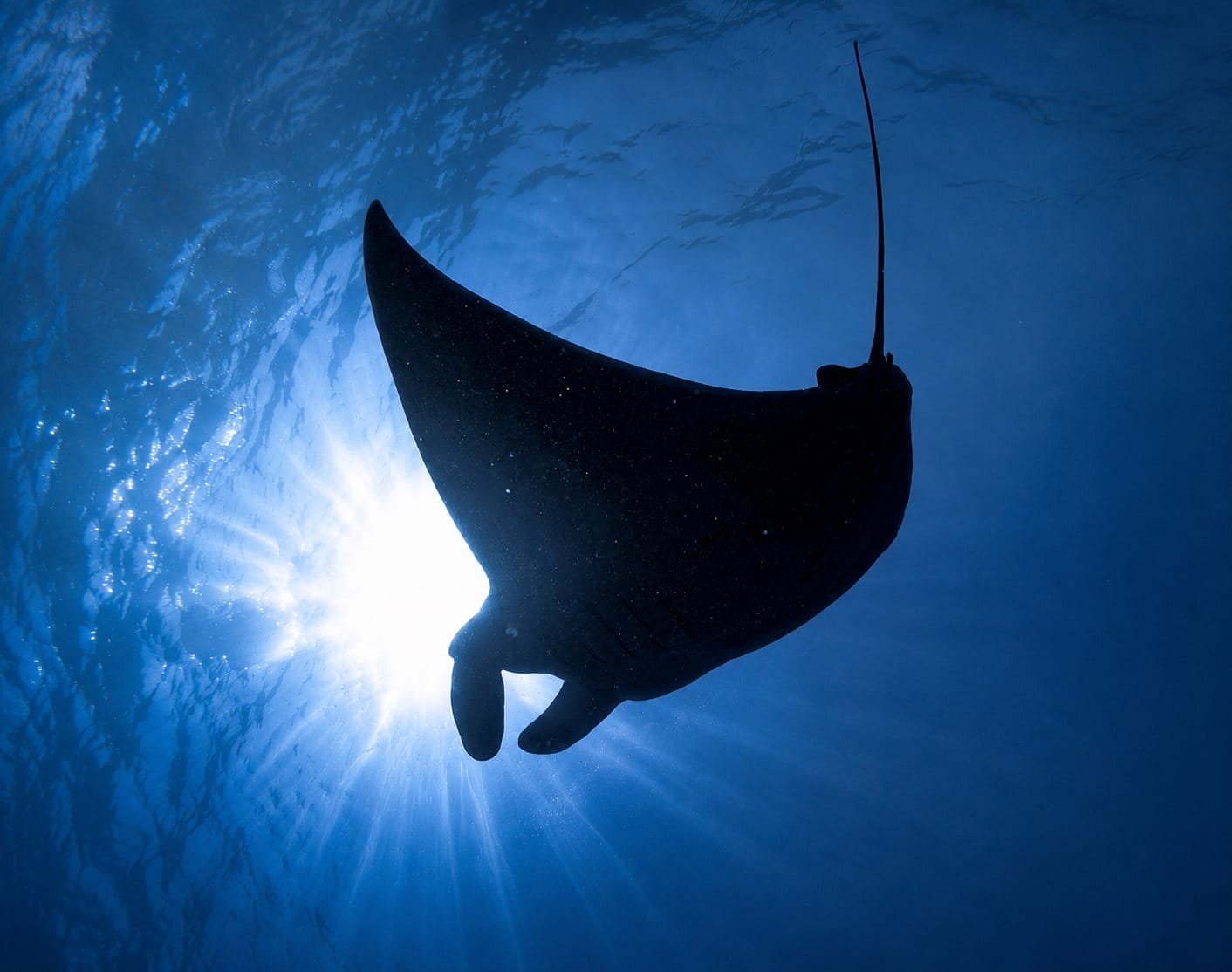
A manta ray silhouette in South Ari’s waters — reef mantas here are year-round residents, not seasonal visitors.
Where Our Guides Search — and Why the Location Changes
Unlike some excursions that always visit the same spot, Vilu doesn't take every manta trip to one fixed location. Our guides check recent manta sightings and sea conditions before deciding which area to search. We don't rely on one fixed manta location.
The crew weighs two things: where mantas have actually been reported recently, and whether the sea and wind conditions on the day make a given area practical and safe to reach and snorkel. Between the two, they choose where to search — it's a judgement call based on current information, not a fixed circuit and not a promise about where mantas will or won't be.
For the broader geography of the atoll: South Ari Atoll Travel Guide →
Cleaning Stations, Feeding, and Other Manta Behavior
Not every manta encounter looks the same, and it's worth knowing what you might see.
Research on reef manta ray behavior has found that mantas can shift between cleaning and feeding depending on conditions — when plankton is abundant, they're more likely to be found feeding elsewhere rather than at a cleaning station; when conditions are less suited to feeding, cleaning stations become the more likely place to find them. Manta Trust explains how reef mantas use cleaning stations: they hover in place — sometimes circling — while smaller fish remove parasites and clean their skin and gills.
On other occasions, you may simply see a manta gliding past — neither cleaning nor feeding, just passing through the area. That's part of why our guides check recent sightings rather than assuming one type of encounter: what you see on any given day depends on what the mantas themselves are doing.
If We Don't Find a Manta Ray
Manta sightings are never guaranteed — they're wild animals, and even searching the right area doesn't mean one will be there. What makes a real difference is what happens next.
If we don't find a manta ray during the search, we'll spend around 30 minutes snorkeling a nearby reef instead, so the trip isn't wasted. Depending on the circumstances, we may also offer a discounted second attempt — there's no fixed discount we can promise in advance, but ask your host about what's currently available.
Shared Trips, Group Size & Private Trips
This is a shared excursion with a minimum of 2 participants; if others are booked for the same day, guests are typically combined onto the same trip.
If you'd prefer to go out on your own, a private trip is available on request, and additional charges may apply. The same applies if you're the only guest interested that day — a solo booking may carry an additional charge rather than the shared-trip rate.
Crew and guide numbers increase with the number of guests on board, so a larger group gets more support in the water; there's no single fixed ratio we can quote in advance since it depends on the day's booking.
Who Can Join — Swimmers, Weak Swimmers & Children
Confident swimmers, weak swimmers and families with children may be able to join, but swimming ability and sea conditions matter.
If you're not a strong swimmer, that's not automatically a reason to sit this one out — just let our staff or your guide know beforehand, so they know what kind of support you might need in the water. Every boat carries free life jackets for anyone who wants one. That said, a life jacket alone doesn't automatically mean it's the right moment for someone to get in the water — sea conditions and your guide's judgement on the day still matter, and the guide may advise against entering the water in some circumstances even with a life jacket available.
Children are welcome with a parent's approval, and parents should let us know beforehand what their child's swimming ability actually is. Children who can't swim well aren't recommended to enter the water for this excursion — they're welcome to stay aboard and watch instead, and the usual excursion charges may still apply either way.
Safety Briefing & Responsible Manta Encounters
Before anyone gets in the water, your guide runs through a short safety and encounter briefing — how the search will work, what to expect, and how to behave respectfully around a manta if we find one.
Manta rays are a legally protected species in the Maldives. Beyond that legal protection, Manta Trust — a leading manta research organization — publishes its own best-practice recommendations for snorkeling with mantas.
Manta Trust's best-practice recommendations: enter the water calmly rather than jumping in near the animal; don't swim directly at it; approach from the side rather than head-on; let the manta set the distance rather than chasing it; and never touch. These are Manta Trust's recommended guidelines, not a Maldivian legal distance requirement — the Maldives doesn't currently mandate a specific interaction distance for manta rays the way it does for whale sharks. Your guide will brief you on how to apply this in practice before you enter the water.
For the full South Ari Atoll picture — whale sharks, local islands, and getting here: South Ari Atoll Travel Guide →
Weather & Trip Changes
We check conditions before heading out, and if the weather isn't suitable, you'll be informed beforehand — the trip may be postponed or cancelled rather than run in unsafe or unpleasant conditions. Booking a spot doesn't guarantee the excursion runs exactly as scheduled if the weather doesn't cooperate.
This is separate from cancelling your accommodation booking — for that, see our general booking and cancellation policy →
Is There a Best Season?
There isn't one fixed "best month" that we promise for manta snorkeling from Maamigili. Reef manta rays are year-round residents of Maldivian waters, but their distribution and behavior can shift with monsoon-driven conditions and food availability. Because of that, our guides check recent manta sightings and sea conditions and search the areas that currently appear most promising, rather than taking every trip to one permanent manta site.
That doesn't mean sightings are equally likely in every month or location. Mantas are wild animals, and no season or search area guarantees an encounter.
For weather patterns and when to visit generally: Best Time to Visit guide →
What Should You Bring?
- Swimwear, worn under your clothes for a quick start
- Reef-safe (mineral) sunscreen — protects both you and the reef
- A hat and sunglasses for the boat ride
- A change of clothes for afterward
- Your own camera or GoPro, if you'd like your own photos
What's Included
Snorkeling equipment, towels, fresh fruit, and water are included on every manta ray excursion.
Price & Booking
Manta ray snorkeling is bookable on its own from USD 85 per person, though we'd recommend confirming the current price with our team before booking, since it can change. A normal shared trip requires a minimum of 2 participants; if you're the only guest interested, or you'd prefer to go privately, additional charges may apply.
Manta ray snorkeling is also included in several of Vilu's current holiday packages, alongside accommodation, round-trip transfer, and breakfast at their own package pricing.